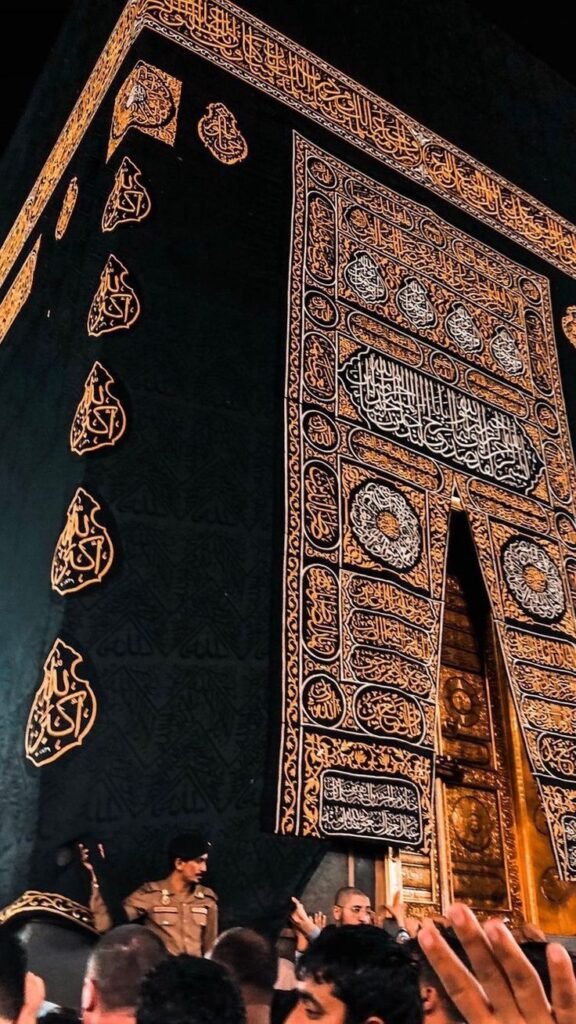
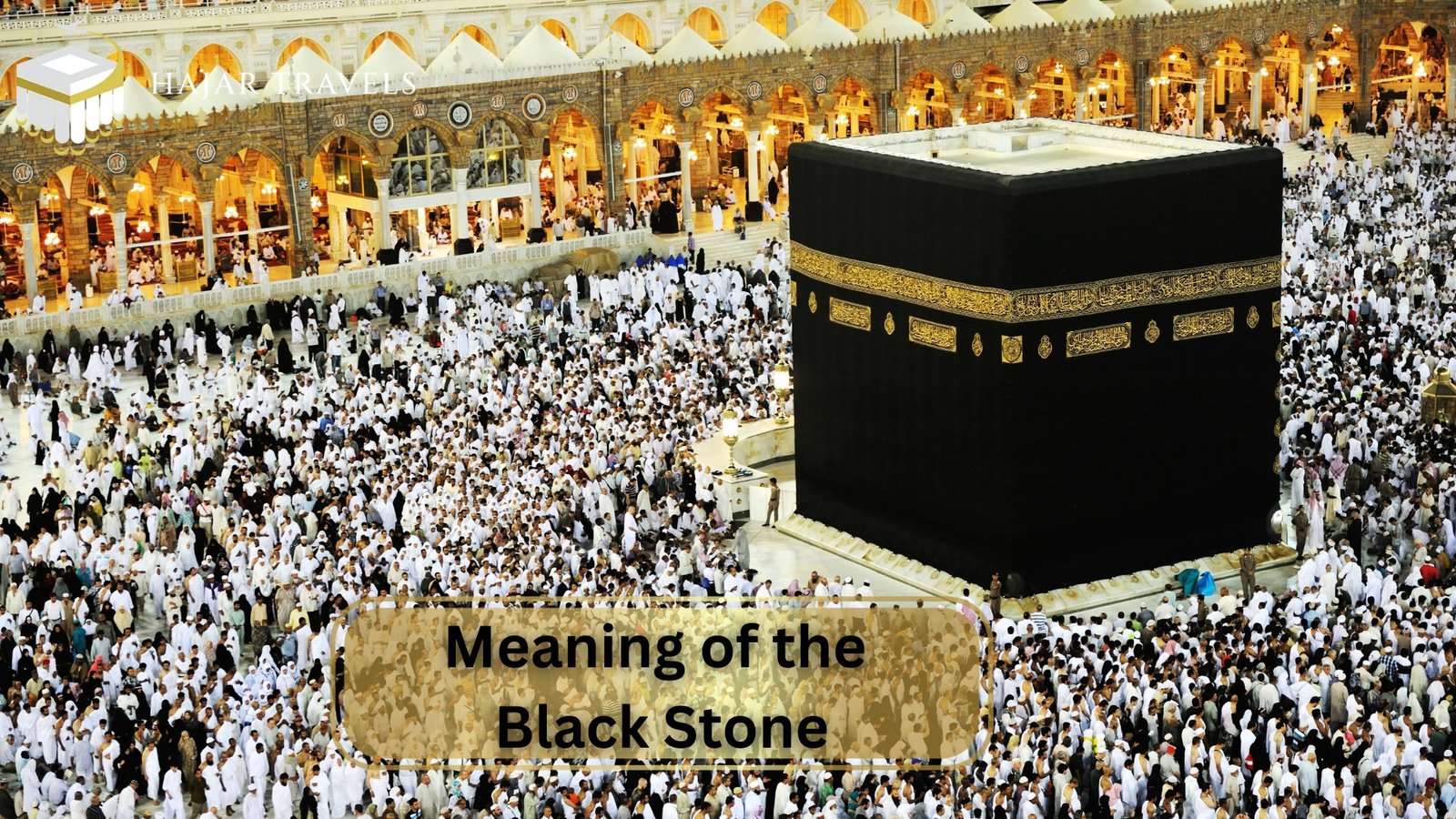
Black stone, which is situated in one of the eastern corners of the Kaaba in the Grand Mosque of Mecca, is a religious symbol. It is a centuries-old ritual that is practiced on the spot by millions of pilgrims every year who touch or gesture towards it. It is neither an idol nor remembrance of faith. But it helps believers associate with their past, prophets, and God to add more knowledge on Hajj and Umrah ceremonies.
The Black Stone (al-Hajar al-Aswad) is an essential fragment of the Islamic history. Which is thought to be a rock, which was brought to the earth by heaven. It has been the focus of prayers and worship of generations and the beginning and the end of the Kaaba tawaf in pilgrimage. The Black Stone is a holy part of the hearts of more than one billion Muslims that has its strong connection with religion. In this paper, the paper will delve into its rich history. As well as provide an insight as to why it is so revered by those who follow the Islam religion all over the world.
The Black Stone represents having a direct connection with Prophet Muhammad (peace be upon him) and his practices. The pilgrims kiss or touch it to show love and respect, in accordance with the Sunnah. It is a beginning to the tawaf circle where the past meets the present and gives pilgrims the feeling that they are connected to the origins of their faith.
The Origins and History of the Black Stone
The history of the Black Stone is enveloped in a combination of historical narrations and religious heritage. The Islamic faith is that it is not a part of this world but it was sent by Jannah (Paradise). Tradition has it that the stone was originally a pure white to which the sins of humanity changed its color to black. This itself is a strong symbolism of how the stone was a silent witness of the fallibility of men and how they needed divine mercy. Umrah Packages from Chicago is an opportunity to visit this religious place with those who want to make a spiritual trip.
Pre-Islamic Era
The Kaaba and the Black Stone were the deities of the pagan tribes of Arabia many years before the Islam religion came into being. The Kaaba was a sanctuary, one that harbored idols of various gods and the Black Stone was something to worship already. It was found in the Kaaba because the times of Abraham (Ibrahim) and his son Ishmael (Ismail) who are supposed to have built the religious edifice as monotheistic worship centre. The stone was thus a fragment of this primal pure faith despite the fact that the Kaaba had been crowded with idols in the future.
It was an important event in the pre-Islamic history of the stone as it happened during the reconstruction of the Kaaba and the Prophet Muhammad was still a youth. A conflict ensued between the chiefs of the Quraysh tribe as to who should have the honour of replacing the Black Stone in its niche. The situation was quite intense, and war appeared to be very close. The seniors accepted to allow the first one who came into the sanctuary to make the decision. That individual was the future Prophet who was already known at the time to be upright and wise as al-Amin (the Trustworthy).
Another brilliant and nonviolent solution that Muhammad had arrived at was also brilliant. He threw his cloak on the ground, and placed the stone in the centre and commanded one of every one of the warring groups to seize an angle of the cloak. The rock was lifted in unison. Muhammad the same carried the stone there himself and set it. This is what made bloodshed averted in addition to being a mark of his unity and wisdom, many years before his first revelation.
Islamic Era
The Kaaba was purged of its idols with the coming of Islam and its mission was brought back to the monotheistic worship of the one God, Allah just like it was initially meant to be by Abraham. The place of honor of the Black Stone was not based on the concepts of polytheism, but redefined in the context of monotheism. The Prophet Muhammad (peace be upon him) approved the rituals of Hajj such as the tawaf round the Kaaba and worshipping of the stone.
It is not a worship when a person touches or even kisses the stone. It has been made clear by one of the nearest companions of the Prophet, Umar ibn al-Khattab. When he kisses the stone he quotes saying clearly that you are a stone and can neither help nor harm. Had not I chanced to see the Messenger of Allah kissing you I should neither have kissed you. This statement is crucial as it is in favor of what the Islamic doctrine of Tawhid (the oneness of God) is known to be, and when it comes to the stone, worshiping it is a way of imitating the Prophet.
The Black Stone has had its dangerous moments in various times of its history. It was stolen by the radical Ismaili Qarmatians in 930 CE and taken to their citadel of Hajar (modern day Bahrain). The period during which it lost the stone was over 20 years before it was finally returned to Mecca. The stone also was eroded and disintegrated over the centuries as well as when Umayyad conquered Mecca in the year 683 CE. It now consists of a few pieces coming together with a silver frame, a monument of its long and chequered history.
The Spiritual Significance of the Black Stone
The spiritual significance of the Black Stone is closely connected with its spiritual signification. Among the Muslims, it is a form of re-connecting to the divine, to historical events, to the prophets, and a symbol of unity.
A Witness on the Day of Judgment
Among the deepest beliefs that relate to the Black Stone is the fact that it will bear witness on the Day of Judgment. The prophet Muhammad (peace be upon him) is reported to have said that the stone will have eyes and tongue to testify to those who touched it with sincerity and faith and with tongue. This faith gives the process of laying hands on the stone a heavy spiritual curse. It is not just a historical ritual but an action which will result in the afterlife. Pilgrims go to the stone with the feeling of awe and hope because they believe that this silent observer will one day talk on their behalf.
A Symbol of the Covenant
The Black Stone is also seen to be a symbol of covenant between God and man. One of the comparisons made with touching it is shaking hands thus proving the bond of loyalty and submission to Allah. Something that makes an actual reminder of the primordial covenant that existed between God and the souls of all the humankind to serve him solely. Whenever a pilgrim touches the stone or indicates the stone during tawaf, he is repeating this intimate vow and in pledging himself to his belief in the most intimate sense of that word.
A Point of Unity
Millions of people in Mecca have an encounter with people worldwide in the Hajj and Umrah. They have different cultures, do not speak the same language, and they have different traditions. Kaaba and the Black Stone are very significant symbols of unity in this big ocean of difference. They all are directed to one direction and towards the same point, and pilgrims walk around Kaaba, their differences are dispelled. The black stone is their uniting element, and one object of worship that enables them to feel that they are united in purpose and share the same identity as Muslims. It acts as a reminder to them that despite the fact that they represent various backgrounds, they all are part of one world, the Ummah.
The Rituals Involving the Black Stone
The Black Stone rituals form the main focus during the Hajj and Umrah performance.
Starting Point of Tawaf
A major ritual of both pilgrimages is the tawaf which is the circumambulation around the Kaaba seven times. At the start and the finish of every circuit, there is the Black Stone. Pilgrims begin every round with seven rounds by facing the stone, performing a ceremony of recognition, which is known as istilam, and uttering Allahu Akbar (God is the Grandest). This act directs the pilgrim and preconditions the circumambulation.
Kissing, Touching, or Pointing (Istilam)
It is the Islamic practice and it is believed to be very holy and it is known as kissing of the Black Stone like Prophet Muhammad did. However, it is not necessarily possible due to the large audiences. In this case pilgrims are not only encouraged to hold the stone with the right hand but also to kiss it. Should that even be impossible, they should resort to the stone, and with their right hand, point to it, and say Allahu Akbar. This is referred to as istilam and it is also of the same spirituality. This lax style is what assures every pilgrim, maybe physically feeble or simply in the press, of belonging to this religious practice and this is what centers on the meaning and core of the Islamic teaching.
This interpretation of the meaning of the Black Stone turns the pilgrimage from a journey of a physical character to the spiritual journey of immense characteristics. It is a re-identification with a past that goes back to the beginning of monotheism and a self-reestablishment of the personal belief. To the people intending their pilgrimage visit to Hajar Travels, this background gives a new dimension and meaning to every action taken within the sacred city of Mecca, which makes the experience a life-changing one.
Find a Deeper Connection
The Black Stone is much more than a religious artifact; it is a breathing icon of the core of the Islamic religion. It is a direct connection to the Prophet Muhammad, a connection to the divine and an influential symbol of unity to Muslims across the world. Its history speaks of the strength of religious belief as it has endured centuries of violence to continue serving as a place of worship. Although the stone in itself has no power, the religion of its worship has a profound spirit of spirituality that serves to remind the faithful of their relationship with God and on the Day the actions of the faithful will be measured.
Next time you are planning your religious pilgrimage of Hajj or Umrah, do not hesitate to rethink the significance of these religious activities. Hajar Travels will be careful to make sure that the pilgrimage process they provide is not just comfortable and easy, but spiritual too. Something we would like to help you to do is to make you a trip that would bring you together with the rich history as well as the essence of the most sacred places in Islam.