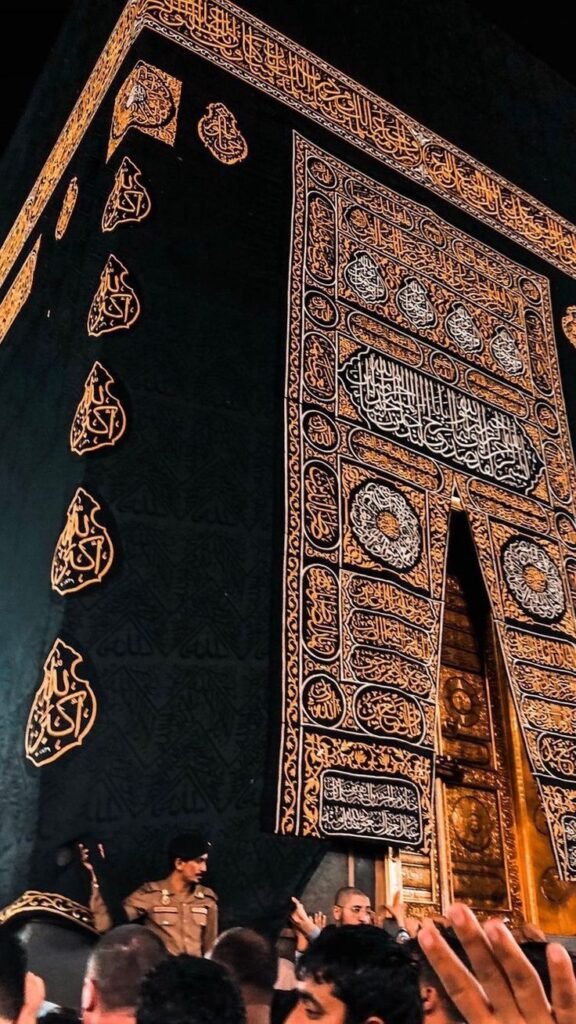
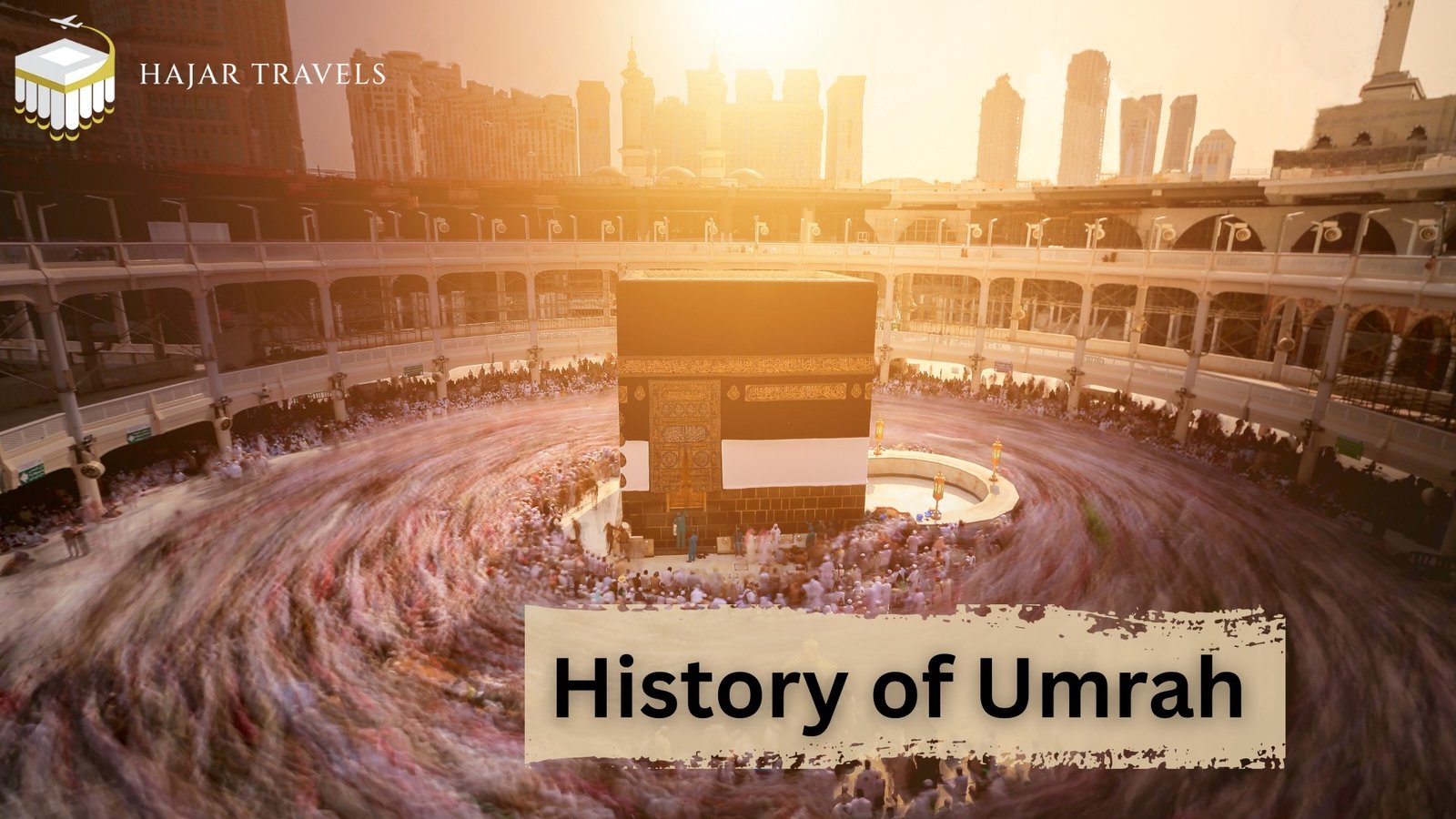
It is a beat to the hearts of millions of Muslims living all over the world who have always longed to visit the Holy City of Mecca. It is a kind of experience when, in front of the Kaaba, one is covered with black silk and gold, and it provides a feeling of peace which is hard to experience in other places. Nevertheless, this journey is not merely a physical voyage over the borders but it is a spiritual one through time. The movements that are made during Umrah are not something randomly made; they are the duplications of history, repeating the similarity of the faith of prophets and the strength of the faithful who stood on these sands thousands of years back.
To fully understand how great the pilgrimage is, one should take a look back into centuries long tradition that formed it. Knowing the origins and development of this holy action changes this visit to a complete attachment to the Islamic heritage.
The History of Umrah
Umrah history is deeply religious, struggling and God commanding. This can be attributed to the fact that contrary to Hajj, which is the major pilgrimage, which is conducted on specific days. The minor pilgrimage Umrah can be conducted in every day. It also traces back to the days of Prophet Muhammad (PBUH). But it is more so dated back to the times of Prophet Ibrahim (Abraham). His family than Prophet Muhammad (PBUH). Umrah has remained a victim of inquisitiveness of pre Islam and the Islamic wars and empires that have risen and fallen over the centuries. It remains a global worship even today. Cheap Umrah packages 2026 are a cheap way of having this holy pilgrimage to those who might wish to have it.
The Abrahamic Origins
The valley of Mecca was a lifeless desert long before the minarets of the Grand Mosque put their heads in the skyline. It was initiated by the story of Prophet Ibrahim who, acting on the orders of God, abandoned his wife, Hajar and their baby son, Ismail, in this barren valley.
Their struggle to survive is closely connected with the rituals of Umrah. The Sa'i, which is the process of walking briskly between the hills of Safa and Marwa is a direct remembrance of the desperate search of water that Hajar made to find a way to save her dying son. Her undying belief was justified when the well of Zamzam pumped out of the ground.
Ibrahim later came back to construct Kaaba together with Ismail. The two of them strengthened the foundations of the House of God and made it a home of monotheism. They invited humanity to this house and the pilgrimage became a tradition. The representatives of the Abrahamic tradition had visited the Kaaba centuries to worship the one and only God.
The Era of Jahiliyyah (Ignorance)
During the course of centuries, the wholeness of the Abrahamic message came to be eroded in the Arabian Peninsula. These custodianship of the Kaaba became the discretion of different tribes and they at length came into possession of the Quraysh. This era is referred to as Jahiliyyah and the holiness of Kaaba was lost.
The house of God was constructed with the aim of monotheism but ended up having more than 360 idols. The pilgrimage rituals were mutated. Although the Kaaba was still worshiped by the local tribes who still practiced circumambulation (Tawaf), they were combined with paganism, applauding, whistling, and venerating stone gods. Behind the superstition and the pride of the tribes, the spiritual spirit of Umrah was buried.
The Prophetic Restoration
With the arrival of Islam, the Kaaba was restored back to its original use. This was not however an instantaneous change. This is because the Prophet Muhammad (PBUH) and his adherents spent years praying to Jerusalem and were not allowed to enter into Mecca by the Quraysh.
The Treaty of Hudaibiyah
One of the most significant Incidents of Umrah was the one that happened in the 6 th Hijra year (628 CE). One of the things, which the Prophet (PBUH) would dream of, is visiting Mecca and doing Tawaf. This gave him an inspiration and together with 1,400 of his followers he embarked on the journey wearing the Ihram (garment of pilgrims) to serve as a sign of peace.
They were camped at the Hudaibiyah, the frontiers of Mecca. They were not accepted by the Quraysh. It was a hyped atmosphere, the Muslims would have loved to be in Kaaba yet they were prohibited. This was a battle which led to the treaty of Hudaibiyah. This appeared to be a loss to them because they would not be able to forge Umrah in the same year but this treaty guaranteed a 10 year ceasefire and a right to retaliate the next year.
The Fulfilled Umrah (Umrah al-Qada)
The Prophet and 2,000 Muslims went back to Mecca during the 7 th year of Hijra (629 CE). In the course of the agreement, the Quraysh left the city in three days. This was referred to as Umrah al-Qada (The Fulfilled Umrah), it was the first time in many years that the call of Labbayk Allahumma Labbayk (Here I am, O Allah, here I am) was heard clearly in the valley, and could not be interrupted by the clamor of idolaters. It was a highly emotional scene and triumph of the soul and restoration of the rite that Ibrahim had initiated.
The Conquest of Mecca
This rebuilding is the most recent done when the Mecca was conquered in 8 AH. Without any commotion, the Prophet Muhammad (PBUH) came to the city and directly went to Kaaba. He ran round the sacrificial house, and at a single stride struck down the 360 images, and said the verse: Truth has (now) come, and Falsehood has perished: because Falsehood is (by nature) possible to perish, (and) Falsehood is (by nature) possible to be born again (as well). (Quran 17:81).
Since then, the rituals of Umrah and Hajj have been sacrificialized. The pagan appendices were stripped and the pilgrimage was returned to the worship of the one God.
Expansion and Stewardship: The Caliphates to the Ottomans
Since the death of the Prophet, pilgrims started increasing gradually. The first Caliphs understood that they had to be able to accommodate the faithful.
The Rashidun Caliphate
The land enclosed by Kaaba was widened under the reign of Umar ibn al-Khattab and Uthman ibn Affan. They also bought the houses surrounding the building to enlarge the courtyard and it also created new walls to establish the boundaries of the mosque. They also put in place measures of controlling floods because the valley was prone to flash floods.
The Abbasids and Ottomans
The Grand Mosque enjoyed expansion with the expansion of Islamic empire. Abbasids included the decorations as ornate columns and inscriptions. The Ottoman Empire in the future was very instrumental in preserving the holy sites over the centuries. They constructed the well known colonnades (some of which are observable up to this time) and enhanced the access roads to Mecca. The Hejaz Railway which was mainly built to facilitate Hajj transformation happened to be the revolution of the mode of transportation to the land since the journey became less dangerous to those traveling to the land.
The Modern Era of Umrah
The greatest physical developments that have happened to the Umrah experience have been experienced in the past 100 years under the leadership of the Saudis. The pilgrims went through a change in their demographics due to the discovery of oil and the convenience of air travel. What used to take thousands of people most of whom travelled on camel or foot became a journey of millions of people who travelled on jet.
This influx has seen the Masjid al-Haram experience colossal expansions.
First Saudi Extension (1955-1973)
King Saud undertook an overall reconstruction which involved new minarets as well as replacement of the old structures by marble and stone.
King Fahd Expansion (1982-1988)
It was planned with colossal expansion that incorporated air conditioning facilities, escalators and a new wing which significantly increased capacity.
King Abdullah and King Salman Expansions
The contemporary world has experienced the most massive growth ever. The Mataf (circumambulation space) was expanded to accommodate more than 100,000 pilgrims every hour. There is also high-speed train that is linking Mecca and Medina making it just a few hours to travel.
Technology is an important aspect today. Visas are provided electronically, applications are used to control the number of people at a particular time, and feeding and accommodation of millions of people is performed with accuracy. However, the fundamental rituals have not changed in the marble floors and cooling mist fans. The Pilgrim still wears two sheets of white cloth as did the Companions. They continue to race between Safa and Marwa in recognition of the plight of Hajar.
Reflecting on the History of Umrah
When you are planning your trip it is a good idea to look back on the history of Umrah as a means to have an eye opening. It helps the pilgrim to remember that they are not just visiting an ancient city, but they are members of a covenant in antiquity. Each move made on the cool marble of the Grand Mosque is a move made on sacred territory where history was written. Patience is an understanding of the plight of the Prophet at Hudaibiyah. The experience of isolation of Hajar teaches not to doubt God. This historical consciousness makes the physical rites into a highly psychological and intellectual experience of the modern believer that may be linked to the heroes of the past.
Your Journey Awaits
Umrah history is not only discovered in books, but it is smelled in the air of Mecca. It is a heritage of religion which has been preserved and given over generations. It is either the towering minarets that are torn to the heavens or it is the old stones of the Kaaba, every inch of the sanctuary speaks of submission to the Divine.
When you prepare to go on pilgrimage, bear in mind that you are just another page in this history that keeps going. At Hajar Travels, we realize how heavy this trip is. Our mission is to help you to make your spiritual journey in a dignified and comfortable way that enables you to concentrate on the worship and the history around you.