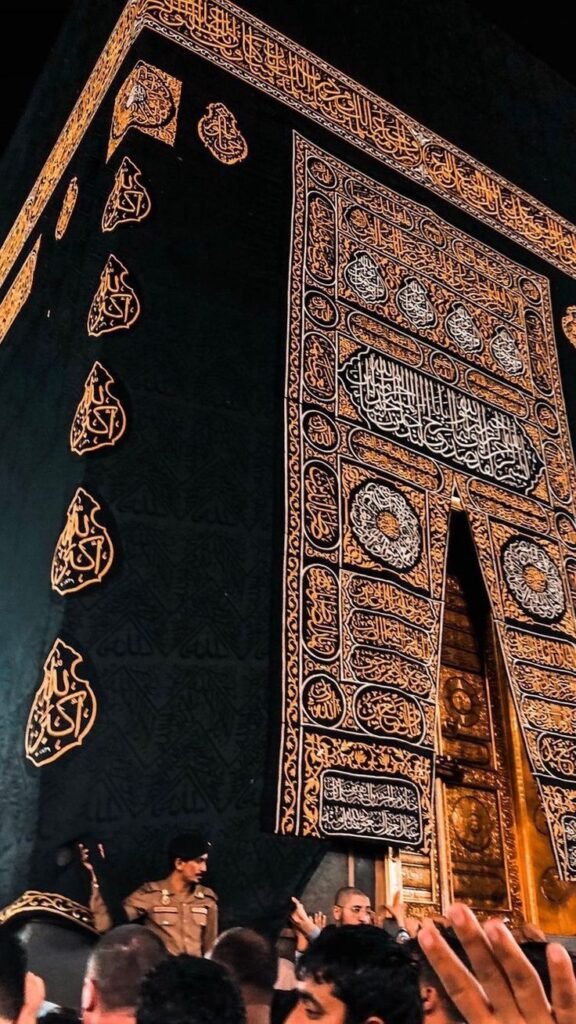
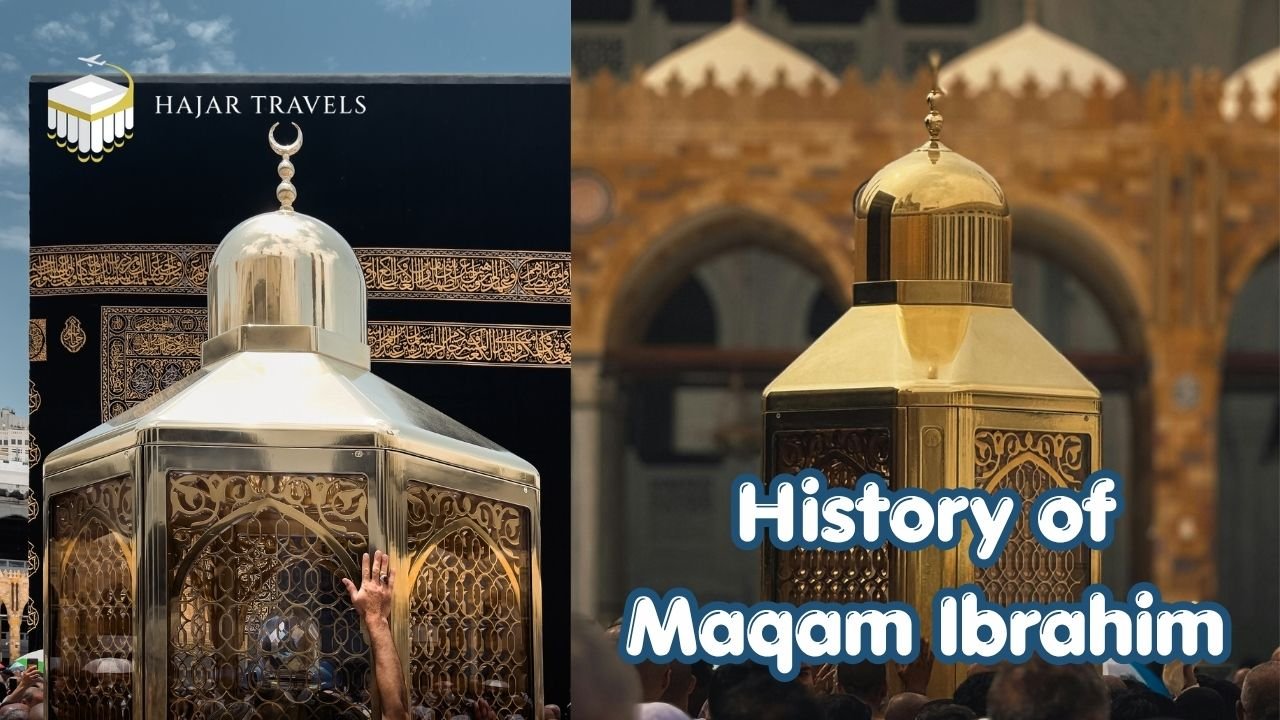
Maqam Ibrahim (the Station of Abraham) to the holy stone containing the miraculous foot-prints of Prophet Ibrahim. He stood here on this stone while they were constructing the upper walls of Kaaba in Mecca with his son Prophet Ismail. As of today, it is located in a golden and crystal structure. At the foot of the Kaabah, after Tawaf pilgrims spend two units of prayer behind it.
Every year, pilgrimage draws millions to Litharbrys, Mecca. Upon entering the Masjid al-Haram itself and seeing the grandeur of the Kaaba, something else draws their attention. Resting under a lovely golden and crystal dome is a rectangular lump of stone with two unique depressions. Enter Maqam Ibrahim, an ancient relic that bridges the time-space continuum of the worshippers of one God. Back to its foundation through history, just like their archaic father and monotheistic prophet himself: Prophet Ibrahim.
When you are preparing for the sacred path, learning about the landmarks of Mecca is an important part of spiritual preparation. Understanding the history of Maqam Ibrahim can certainly enhance your Umrah or Hajj, as it strives to move beyond just the circumambulation of these holy rites towards a deeper theological understanding contained within the confines of this sacred area of Masjid Al-Haram.
Planning Ahead with Umrah Packages 2026
Just like any pilgrimage, a spiritual journey needs to be planned and booking your trip in advance can certainly take the stress out of your travels. Hajar Travels offers you detailed Umrah Packages 2026 to cover the variegated needs of contemporary pilgrims. If you book your Umrah Packages 2026 months in advance, you can avail of good rates and fare, get the best hotels nearby to the Haram for a comfortable stay and do not have to face the hassle at the last hour for visa processing. Hajar Travels pride themselves on overseeing all logistical aspects, permitting you to focus completely on your spiritual preparation and the deep history involved when it comes to sacred sites such as Maqam Ibrahim.
What is the true origin of Maqam Ibrahim?
Now if we wish to make some interpretations of the history of Maqaam Ibrahim, then we have to go thousands of years back in time to the time when prophet Ibrahim and Ismail was alive. In Islam, Allah commanded Prophet Ibrahim to build a sacred house (the Kaaba) where devotees would only worship Allah.
This went on and the walls of Kaaba expanded and Prophet Ibrahim could not put those heavy stones at top. Prophet Isma'il had brought a large flat stone, so that his father may stand on it. This stone was operated as a type of divine scaffolding. In Metaphysical texts Prophet Ibrahim when stood on the stone (the stone as by divine intervention became soft) had left behind clear footprints in concrete form that were and are still visible today. Additionally, historical records note that the stone would rise automatically and lay back down so Prophet Ibrahim could easily construct the walls.
Where was Maqam Ibrahim originally located?
We are taught that the stone in Mecca -- al-Hajar al-Aswad -- and its physical location has undergone a succession of changes during Islamic history. Originally at the time of Prophet Ibrahim, it was placed inside the wall of Kaaba. For centuries, it maintained this position.
In the time of Prophet Muhammad, the stone was still placed very close to the walls of the Kaaba. Later, during the caliphate of Umar ibn al-Khattab, the number of pilgrims coming to Makkah increased, and the stone’s position near the Kaaba made Tawaf more difficult during crowded times. Caliph Umar, understanding the need to manage the growing number of worshippers, made the important decision to move Maqam Ibrahim slightly back from its earlier position. This decision was accepted by the companions of the Prophet and became the official position of the station throughout Islamic history. At Hajar Travels, we help pilgrims understand these sacred landmarks so their journey becomes more meaningful, informed, and spiritually connected.
How did past civilizations preserve the sacred footprints?
But how extraordinary is it to keep a special sandstone block that has been blessed by sacred footprints through thousands of years of weather, crowds and historical conflict? Maqam Ibrahim, physically preserved as a piece of rock, is a clear indication of how much the Muslim community holds this artifact with high esteem.
At first in the earliest years of Islam, it was placed loose without covering. Yet with the thousands of pilgrims who came to touch and kiss the stone in search of blessings, Islamic scholars and leaders recognized that eventually the friction will erase some of the unique imprints left by footsteps.
Over the time, different caliphs & rulers built enclosures around the relic to keep it safe. One of the earliest rulers to plump for the encasement in a silver box was Abbasid Caliph Al-Mahdi. The protective case has been renovated and repaired by Jewels of various Islamic empires including the Mamluks and Ottomans through the centuries. The Ottoman Sultan Abdul Hamid II built a gorgeous silver and gold protection for the stone, protecting it from the elements and from the masses.
How is Maqam Ibrahim protected today?
The Saudi government has made great efforts to preserve and showcase Maqam Ibrahim in modern day. The voluminous, very heavy structure which once covered the stone was removed in 1967 during the reign of King Faisal as it was hindering pilgrims making Tawaf.
It is now encased in a sturdy brass and gold casing, referred to as Maqam Ibrahim. The thick, shatter resistant crystal glass of the viewing window gives complete visibility to visitors and pilgrims to view the stone and the footprints but protects this sacred relic completely. Its dimension is some 40 cm × 40 cm × 20 cm. Those impressions demonstrate it is over 10 cm lower.
What are the spiritual lessons we learn from the Station of Abraham?
The Station of Abraham is not simply an antiquity. It represents the utmost in human submission to divine will. During every stage, his test was great — cast into a fire-like flame; sent off with Hajar and baby Ismail to the heart of no-where. Building the sacred Kaaba was a hardship, both physically and spiritually.
Believers who view the footprints recall the physical toil and spiritual commitment necessary for loving God. The pebble that became soft for Prophet Ibrahim signifies that Allah eases the hard jobs of those who have true Iman. In the tens of millions approach, pilgrimage to the holy land is inevitable and what Hajar Travels focuses on as your guide in these tours is an understanding of those historical lessons that weigh heavily on a religious nature when you are there.
Convenient Umrah Packages from Houston
With so many extra and particular considerations to take as a traveler from the USA, one might seek for an understanding travel partner who specialised in journeys — ashore, air and everything in between — that cater completely to the American traveler. Hajar Travels is a leader in providing one of the best options for Umrah Packages from Houston. Our Umrah Packages Houston has now introduced dedicated packages as per your travel requirements whether you are travelling alone or in small/large groups. Under the stewardship of Hajar Travels, Texans and others in the nearby vicinity can leave the rest to experts that are curated specifically to enable your time when renting Maqam Ibrahim and seeing Grand Mosque one to be remembered.
Embracing the Legacy of Prophet Ibrahim
Standing before Maqam Ibrahim is a lesson in humility. It is the link between an individual who worships today, and he that built the Kaaba so many centuries ago. The ancient foot prints, sheltered in stone, set the act of worship, rugged labor and deep submission of Prophet Ibrahim to God.
To pray behind this station is a practice that has continued for thousands of years. Your response to this divine call which belongs to Prophet Ibrahim, as in the end of all generations he built the Kaaba and called humanity at large for pilgrimage. The historical background, preservation and religious enlightenment around the stone are what guarantee that your pilgrimage is not merely a trek but a genuine spiritual awakening. We hope you Hajj is accepted and Prophet Ibrahim inspires your heart to faith from now till you are dust.