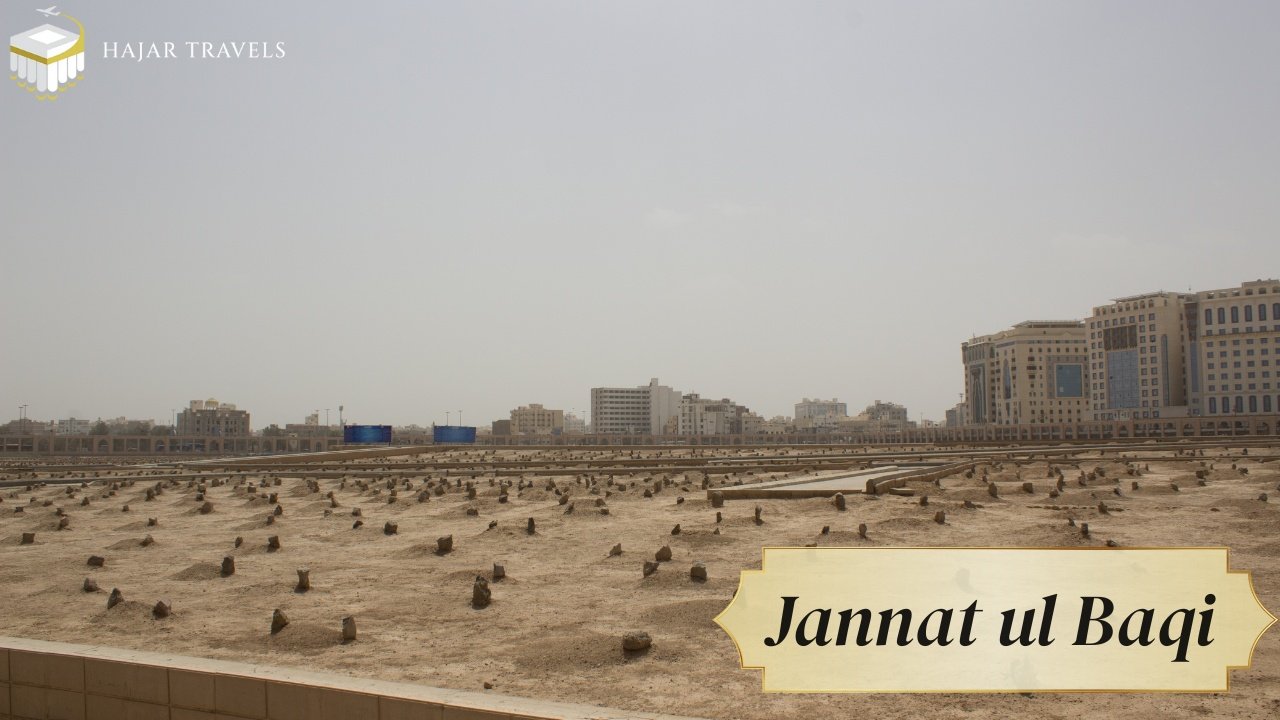
To Muslims worldly, the sacred city of Medina is close to their hearts. It is a peace city, prayer city and has great historical meaning. One of its most sacred places is a plain, though very spiritual, place called Jannat al-Baqi that is a cemetery. This holy land is the place of the entire family, companions and early Islamic personalities of the Prophet Muhammad (PBUH). To pilgrims who visit Jannat al-Baqi, the visit is an excellent and intimidating process which links them to the roots of their religion. This will be a guide on the history of the place, the importance and etiquette of visiting this blessed graveyard.
Jannat al-Baqi is not just a cemetery, but it is a kind of living lesson in the history and principles of the Islamic religion. Its unnamed graves in rows are bitter experience of the Islamic value of being humble and being equal at death. Here, the strongest personalities of the early Islam are observed lying beside. The ordinary Muslims who are stripped of all the worldly powers. The understanding of the personalities of the buried individuals enables one to have an odd idea on the sacrifices, struggle. The unrelenting faith of first generation Muslims. Visit to this place is an avenue of analyzing one life and mortality with the inspiration of the righteous souls who are buried within its walls.
The History of Jannat al-Baqi
The history of Jannat al-Baqi is mixed with the history of the founding of the Islamic community in Medina. Prior to the migration of the Prophet Muhammad (PBUH), the area was a field. Which was surrounded with a thorny bush known as Gharqad. The Prophet (PBUH), after Hijra, wanted an appropriate burying ground to the increasing Muslim community. He decided on this land and prophesied on it himself, and said, I am commanded by Allah to pray forgiveness of the people of al-Baqi.
The earliest companion of the Prophet to have been laid to rest in this place was the companion of the Prophet (PBUH) called Uthman ibn Maz aun, whom the Prophet (PBUH) himself buried and commissioned to be covered with a stone as a marker and said, It is the grave of our forebear. This act made Baqi to be the main cemetery of the Muslim of Medina.
The image of the cemetery has changed over time. Large mausoleums and domes have been noticed on the graves of prominent people throughout centuries, being built by the rulers and wealthy individuals as a symbol of respect. These lavish buildings became the attraction of the pilgrims in search of prayers and blessings. But at the beginning of the 20 th century these grand structures were cleared away. The cemetery returned to a more basic form with unmarked graves that indicate a specific theological perspective in the Islamic tradition. The site is now a small open-air cemetery. The simplicity of graves being a strong reminder of the fact that all believers are equal before God. Need to visit this holy place and other places of worship in Islam. Then you should put your money on reserving Affordable Umrah Packages, tours to make your religious experience rich.
Notable Figures Buried in Baqi
The sacred site of Jannat al-Baqi is the last residence of an unsurpassed assembly of the most religious and influential persons of early Islam. A trip here is going through the pages of the Islamic history. The graves do not bear a marker, yet the details regarding. The person who is resting there have the respect filling the air.
The Family of the Prophet (Ahl al-Bayt)
It has the enormous spiritual significance since various families of the Prophet Muhammad (PBUH) are buried there. This includes:
- His Wives (The Mothers of the Believers): All the wives of the Prophet except Khadijah (who was buried in Mecca) and Maymunah are buried in Baqi: Aisha bint Abi Bakr and Hafsa bint Umar and Umm Salama.
- His Daughters: The most well-known of them was the youngest and most loved daughter of the Prophet, Fatimah al-Zahra. The exact grave where she was buried in Baqi is also unclear. This fact contributes to the mystique and the solemnity of the site. Other daughters including Ruqayyah, Umm Kulthum as well as Zainab have been buried here.
- His Grandson: Hasan ibn Ali, a son of Fatimah and Ali ibn Abi Talib is also buried here.
- Other Relatives: The setting of the tomb of the Prophet aunt, Safiyyah bint Abd al-Muttalib and his uncle, Abbas ibn Abd al-Muttalib is also blessed ground.
The Companions of the Prophet (Sahaba)
Baqi was the final tomb of thousands of the Prophet companions, who had sacrificed their lives to the Islam cause. Among them are:
- Uthman ibn Affan: Uthman ibn Affan was the third Caliph of Islam, and his original grave was within the original area of Baqi. But his grave was subsequently added to the cemetery.
- Abd al-Rahman ibn Awf: Among the Ten Promised Paradise, a friend and highly generous man, was a rich man.
- Sa'd ibn Abi Waqqas: The other one of the Ten Promised Heaven and a famous military leader.
- Uthman ibn Maz'un: This is the first Muhajir (emigrant of Mecca) to be buried in Baqi.
The fact that these are the pillars of the foundation, renders. A visit to Jannat al-Baqi an indispensable visit to Medina.
Etiquette for Visiting Jannat al-Baqi
A visit to a cemetery is a period of gloomy contemplation. A visit to Jannat al-Baqi requires utmost respect and piousness of the proper Islamic behavior. This is to pray to the dead and speculate on his/her self-death to escape forging oneself around activities. Which are viewed to be not part of the norm or illegal.
The following are some of the major guidelines to be adhered to:
- Enter with Humility: Get to the cemetery calmly and in a humble manner. One should first step into the graveyard with the right foot and say this supplication to enter a graveyard: As-salamu 'alaykum ahl ad-diyar min al-mu'minina wa l-muslimin, wa inna in sha' Allahu bikum lahiqun, nas'alu Allah lana wa lakum al-'afiyah. Salutations to you, O residents of this land of the believers and the Muslims. Verily, we will, in sha’ Allah, join you. We ask Allah for well-being for ourselves and for you.)
- Pray for the Deceased: The main objective of the visit is to pray on forgiveness and mercy of those who are buried there. Face Qibla (In Mecca the Kaaba direction) and dua (supply) to those who are living in Baqi.
- Maintain Quiet and Sobriety: Do not talk loudly, laugh or engage in acts that disturb the event in terms of quietness and somber atmosphere. The cemetery does not involve socialization, but reflection.
- Do Not Touch or Venerate Graves: It is unacceptable according to the rules set on the site to touch, kiss, or wipe hands over the graves. Similarly, do not make offerings or light candles or put in flowers. In this respect, such acts are treated as innovations (bid’ah).
The Spiritual Significance of Al-Baqi
A visit to Medina will not be complete without visiting the surroundings of Jannat al-Baqi. The tombs do not give it its spiritual gravitas, but the unity of the souls within it. It is a great statement of the major Islamic ideals of humility, equality, and fleeting nature of the life. When you are in front of the plain graves, which are not marked, you are reminded that everything to do with the worldly titles and possessions are left over when one dies. Everything that is left is the actions and belief.
This situation is conducive to massive introspection. It makes one consider what kind of legacy is going to be left behind. Whether the relationship with God is in good health or not. Even the Prophet Muhammad (PBUH) came as a frequent visitor to Baqi at night to pray to God in its inhabitants, thereby showing an example to his followers. Pilgrims visit the dead and pray over them and by doing so they are not only doing the Sunnah (practice of the Prophet), but are rewarding themselves. It is a reminder to the current generation of Muslims, that they are linked to their righteous forefathers, which forms a continuous chain of faith and prayer dating back to 1,400 years.
A Journey with Hajar Travels
An Umrah or Hajj pilgrimage is a complicated task to plan, but the spiritual gains cannot be measured. In Hajar Travels we know the significance of each stage of this sacred voyage. When we come up with a pilgrimage package. We make sure that you are able to concentrate on your spiritual journey without having any logistical issues. Site visits such as Jannat al-Baqi are accompanied by our experienced guides offering historical background and religious. Advice so that you can relate well with the history of Islam. The details we will take, That you may be his own with prayers and thoughts and blessings That rest upon the holy cities of Mecca and Medina.